90 Days Food Journal with Gratitude: A Practical System for Tracking and Mindful Eating
Establishing a sustainable health routine requires more than fleeting motivation; it demands a structured system that captures data while reinforcing positive behavioral patterns. The 90 Days Food Journal with Gratitude serves as this operational framework, bridging the gap between quantitative nutritional tracking and qualitative mental well-being. For professionals, creators, and entrepreneurs accustomed to optimizing workflows, this journal functions less like a diary and more like a personal performance dashboard. It transforms the abstract goal of "eating better" into a tangible, 90-day execution plan that integrates seamlessly into high-demand lifestyles.
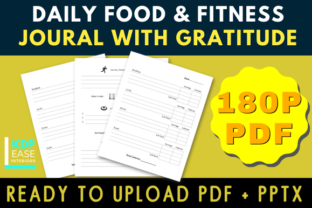
This specific resource is designed as a comprehensive 180-page PDF formatted for 8 x 10-inch paper with bleed, making it immediately compatible with print-on-demand platforms or personal printing services. Whether you are a publisher looking to expand a wellness catalog or an individual seeking a physical tool to anchor your daily habits, understanding the utility and technical specifications of this asset is essential for effective implementation.
The Role of Structured Tracking in Personal Optimization
In any professional or creative workflow, feedback loops are necessary for improvement. You cannot optimize what you do not measure. The 90 Days Food Journal with Gratitude provides a standardized feedback loop for personal health. Unlike generic notebooks, this pre-formatted system removes decision fatigue. Users do not waste cognitive energy designing layouts or deciding what to record; they simply execute the entry. This efficiency is critical for busy adults aged 20–50 who view health management as a parallel project to their career or business responsibilities.
The inclusion of gratitude prompts distinguishes this tool from standard calorie counters. Research suggests that mindful eating practices reduce stress-related consumption and improve adherence to dietary goals. By coupling intake logging with reflection, the journal addresses the psychological component of nutrition. For marketers and educators facing high-stress environments, this dual approach ensures that health tracking supports mental resilience rather than becoming another source of anxiety or administrative burden.
Pre-Implementation: Technical Setup and Customization
Before integrating this journal into a product line or personal routine, proper preparation ensures long-term usability. The asset includes a ready-to-upload PDF, but successful deployment requires attention to technical details. The file is formatted for 8 x 10-inch paper with bleed, a standard trim size that offers ample writing space without being cumbersome for travel or desk use. Publishers must verify that their printer settings align with these specifications to prevent content cutoff or margin errors.
For those intending to sell or distribute this journal, the package includes valuable supplementary assets:
- KDP Cover Template: Ensures precise spine width and cover wrap calculations based on the 180-page count.
- Visual Assets (2 PNG, 2 JPG): High-resolution files suitable for marketing materials, mockups, or digital previews.
- Source File Access: Allows for branding modifications, ensuring the journal aligns with existing visual identities or niche requirements.
Freelancers and small business owners should utilize the source file to add value-added content, such as specific meal prep templates relevant to their audience or branded introductory pages. This customization transforms a generic template into a proprietary tool that fits a specific market segment or personal methodology.
Integrating the Journal into Daily Workflows
The effectiveness of the 90 Days Food Journal with Gratitude depends entirely on integration. A journal that sits unused creates no value. Successful users treat the logging process as a non-negotiable appointment within their existing schedule. Below are practical integration strategies tailored for different user archetypes.
The Morning Review Protocol
For entrepreneurs and creators, mornings often involve strategic planning. Integrating the gratitude portion of the journal into this existing block leverages habit stacking. Instead of creating a new time slot, the journal becomes part of the daily briefing. Writing down three points of gratitude before reviewing business KPIs sets a cognitive tone that can influence food choices later in the day. This proactive approach shifts the journal from a reactive record-keeping task to a proactive mindset tool.
The Evening Data Capture
Professionals with fragmented schedules may find real-time logging disruptive. For this demographic, the journal serves as an end-of-day reconciliation tool. Just as developers commit code or accountants close ledgers, the evening entry consolidates the day’s nutritional data. The 90-day structure provides a defined sprint length, making this evening ritual feel temporary and achievable rather than indefinite. This bounded timeframe appeals to productivity-minded individuals who prefer project-based approaches over open-ended commitments.
Hybrid Digital-Analog Systems
Many users operate within digital ecosystems like Notion, Trello, or Apple Health. The physical journal does not need to replace these tools; it should complement them. Use the 90 Days Food Journal with Gratitude for qualitative insights and mindfulness, while reserving apps for macro-nutrient calculation and trend analysis. The physical act of writing has been shown to enhance memory retention and emotional processing, offering benefits that typing cannot replicate. Periodically transferring key insights from the physical journal to digital archives creates a robust, multi-modal health dataset.
Quality Control and Consistency Factors
Maintaining consistency over 90 days requires managing friction points. When evaluating or using this journal, consider the following factors that impact long-term adherence and product quality.
Paper Quality and Bleed Management: For publishers, the 8 x 10 format with bleed is advantageous for aesthetic appeal, but paper weight matters. Ink bleed-through can ruin the user experience in a double-sided 180-page book. Selecting 60lb or higher paper stock is recommended to ensure markers and gel pens do not compromise adjacent pages. For personal users printing at home, testing single-sided printing or adjusting opacity settings may be necessary depending on equipment capabilities.
Cognitive Load Assessment: The layout must balance thoroughness with speed. If a daily entry takes more than five minutes, compliance drops. The pre-designed fields in this journal mitigate this risk by providing structured prompts. However, users should feel empowered to adapt the depth of their responses. Some days may warrant detailed gratitude reflections; others may require brief checkmarks. Flexibility within the structure prevents the system from breaking during high-stress periods.
Data Privacy and Security: Health journals contain sensitive personal information. For coaches or practitioners recommending this tool to clients, establishing clear boundaries regarding privacy is essential. The physical nature of the PDF-printed journal offers inherent security compared to cloud-based apps, which is a significant selling point for privacy-conscious users. Publishers should highlight this offline capability as a feature for audiences wary of data harvesting.
Leveraging the Asset for Business and Education
Beyond personal use, the 90 Days Food Journal with Gratitude functions as a versatile asset for service providers. Coaches, nutritionists, and corporate wellness coordinators can utilize the ready-to-upload PDF to create program-specific resources. The inclusion of source files allows for the insertion of affiliate links, coaching contact information, or customized instructional guides directly into the journal.
Educators and bloggers can use the provided PNG and JPG files to create accurate visual representations in course materials or articles. Showing potential users exactly what the interior looks like reduces purchase hesitation and sets accurate expectations. The KDP cover template further streamlines the launch process, allowing creators to focus on marketing and curriculum development rather than formatting logistics.
For freelancers offering virtual assistant or organizational services, bundling this journal with client onboarding packages adds tangible value. It demonstrates a holistic approach to client success, acknowledging that professional output is linked to personal well-being. The 90-day duration aligns perfectly with quarterly business reviews, allowing for synchronized goal setting across professional and personal domains.
Long-Term Utility and Iteration
A 90-day cycle is sufficient to establish new neural pathways and habits, but long-term health requires ongoing adaptation. Upon completing the journal, users should conduct a retrospective analysis. Which gratitude prompts resonated most? What times of day yielded the most consistent logging? Did the 8 x 10 format support or hinder portability?
This review informs the next iteration. Publishers can gather this feedback to refine future editions, perhaps adding specialized sections for hydration or sleep tracking based on user demand. Individual users can annotate their source files to create personalized versions for subsequent quarters. The availability of the source file transforms this product from a static commodity into a dynamic platform for continuous self-improvement.
Ultimately, the 90 Days Food Journal with Gratitude succeeds because it respects the user's time and intelligence. It provides professional-grade structure for a deeply personal endeavor. By treating nutrition and mindfulness with the same rigor applied to business projects, users create a sustainable foundation for high performance. Whether utilized as a personal accountability partner or a scalable business asset, its value lies in its readiness for immediate, practical application.