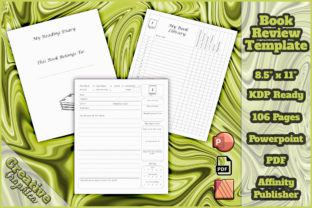
Book Review Template KDP Interior: A Strategic Asset for Low-Content Publishing
In the competitive landscape of Amazon KDP, success is rarely accidental. It is the result of deliberate product development, market understanding, and operational efficiency. The Book Review Template KDP Interior represents more than just a collection of blank lines; it is a foundational asset for publishers targeting the enduring niche of reading journals and literary logs. For entrepreneurs, marketers, and creators operating in the low-content or medium-content space, this manuscript serves as a strategic tool to streamline production while maintaining professional quality standards.
This specific interior manuscript is designed with contemporary aesthetics and functional utility in mind. Spanning 106 pages in a standard 8.5 x 11 trim size, it provides structured space for recording 100 distinct book reviews, with one review allocated per page. Crucially, it includes a four-page index at the front for easy navigation and a "Belongs To" page to establish ownership. However, the true strategic value lies not merely in the pre-formatted PDF, but in the inclusion of editable source files (PPTX and AFPUB). This distinction transforms the product from a static commodity into a flexible platform for brand building and portfolio diversification.
Strategic Positioning Through Customization
The primary risk in the KDP interior market is saturation. Thousands of identical generic log books compete for visibility, often resulting in a race to the bottom regarding price and ad spend. Utilizing the Book Review Template KDP Interior effectively requires moving beyond the "upload and forget" mentality. The inclusion of Microsoft PowerPoint and Affinity Publisher files is a critical differentiator that supports long-term business goals.
By leveraging these editable files, publishers can create unique variations that speak to specific sub-niches rather than a general audience. For example, a marketer might adapt the template to create a "Business Book Analysis Log" by modifying prompts to focus on ROI, actionable takeaways, and networking opportunities. An educator could adjust the layout to emphasize literary devices, themes, and pedagogical applications. This level of customization aligns the product with specific user intents, improving conversion rates and reducing direct competition with generic alternatives.
Furthermore, editing the source files allows for branding integration. Freelancers and small business owners can add logos, custom fonts, or proprietary methodologies to the interior. This turns a simple book review log into a lead magnet or a branded merchandise item that reinforces authority in a specific domain. The ability to modify the master file ensures that every published title contributes to a cohesive brand ecosystem rather than existing as an isolated, disposable product.
Operational Efficiency and Quality Control
For decision-makers managing multiple titles or scaling a publishing operation, time is a finite resource. Developing a high-quality, professionally typeset interior from scratch requires significant design expertise and hours of labor. The Book Review Template KDP Interior functions as a verified baseline, eliminating technical friction points that often delay launches.
The manuscript is pre-formatted to KDP specifications, mitigating common rejection risks associated with margin errors, bleed settings, or gutter miscalculations. The 8.5 x 11 trim size is a strategic choice for this niche; it offers ample writing space compared to smaller formats like 6x9, making it preferable for users who write detailed annotations or use the log for academic purposes. By starting with a technically sound foundation, creators can redirect their energy toward keyword research, cover design, and marketing strategy—activities that directly drive revenue.
However, efficiency should not come at the cost of due diligence. While the provided PDF is KDP-ready, relying solely on it without review is a strategic error. Publishers must verify that the template’s current state meets the latest KDP guidelines, as platform requirements evolve. Additionally, testing the print proof is essential to ensure the paper weight and ink opacity meet customer expectations for a writing journal. Operational excellence involves validating the supply chain, even when using digital templates.
Enhancing User Experience Through Intentional Design
The longevity of a KDP product depends heavily on customer satisfaction and organic reviews. The structure of this Book Review Template KDP Interior reflects an understanding of user behavior. The allocation of one full page per review prevents the frustration of cramped writing spaces, a common complaint in competitor reviews. The four-page index addresses the retrieval problem; a log book containing 100 entries becomes useless if the owner cannot locate past insights quickly. These features are not decorative; they are functional solutions to user pain points.
When planning your product launch, consider how these features translate into marketing copy. Highlighting the "one review per page" specification manages expectations and attracts serious readers. Emphasizing the index positions the book as a reference tool rather than a mere diary. For bloggers and influencers reviewing this product or selling it to their audience, articulating these usability benefits builds trust and demonstrates E-E-A-T (Experience, Expertise, Authoritativeness, and Trustworthiness).
The blank last page included for customization also serves a dual purpose. For the end-user, it offers a space for personal notes or a reading wish list. For the publisher, it represents an opportunity to include a call-to-action, a QR code linking to a newsletter, or a prompt for leaving a review. Thoughtful use of this white space can extend the customer lifecycle beyond the physical purchase.
Risk Mitigation and Contextual Awareness
While the Book Review Template KDP Interior offers significant advantages, it is not a guaranteed path to profit. Strategic practitioners must recognize the limitations and risks inherent in template-based publishing. The most significant risk is lack of differentiation. If you upload the unedited PDF, you are entering a marketplace where identical products already exist. Without unique cover art, distinct metadata, or interior modifications, the product lacks a value proposition.
Another consideration is market fit. Not all reading communities require a 100-review capacity or an 8.5 x 11 footprint. Some niches prefer compact, travel-sized journals, while others may need specialized fields for genre-specific tracking (e.g., cookbook ratings vs. sci-fi world-building). Blindly applying this template to every reading-related keyword is a misallocation of resources. Conduct thorough niche validation before committing to production. Analyze best-seller ranks, read negative reviews of competing products to identify gaps, and ensure this specific template architecture solves a verified problem for your target demographic.
Intellectual property awareness is also paramount. Ensure that any modifications made using the PPTX or AFPUB files respect licensing terms. Understand whether the license permits unlimited commercial use, requires attribution, or restricts resale of the modified template itself. Legal clarity protects the business from future disputes and ensures sustainable operations.
Planning for Long-Term Portfolio Value
Treat the Book Review Template KDP Interior as a component of a broader content strategy rather than a standalone lottery ticket. Successful publishers build ecosystems. This template can serve as the core product in a series. Once the base version is established, use the editable files to create companion volumes: a "Quarterly Reading Reflection" workbook, a "Book Club Discussion Guide," or a "Student Literature Tracker." Each variation targets adjacent keywords and captures different segments of the market.
Consider the seasonality of the reading niche. Q4 often sees spikes in gift purchases, while January aligns with "read more" resolutions. Planning your customization and publication schedule around these cycles maximizes visibility. Use the template to rapidly deploy seasonal variants without redesigning the entire interior. This agility is a key advantage of owning editable source assets.
Finally, integrate feedback loops. Monitor customer questions and reviews for insights into how the template is actually used. Are users skipping certain sections? Do they request more space for quotes? Use this data to inform future iterations of the Book Review Template KDP Interior. Continuous improvement based on real-world usage transforms a static template into a dynamic product line that evolves with market demands.
Making Informed Decisions for Sustainable Growth
Ultimately, the decision to utilize this manuscript should be grounded in business logic. Evaluate the cost of the template against the potential lifetime value of the resulting products. Factor in the time saved on formatting versus the time required for meaningful customization. Assess whether the 106-page count aligns with your pricing strategy and royalty goals. At 8.5 x 11, printing costs are higher than smaller formats; ensure your price point accommodates this while remaining competitive.
For educators, freelancers, and professionals, this template also holds internal value beyond KDP sales. It can be adapted for internal knowledge management, team reading programs, or client gifts. Diversifying the application of the asset improves return on investment and reduces reliance on a single revenue stream.
The Book Review Template KDP Interior is a robust starting point for those willing to apply strategic thought to its implementation. It solves technical hurdles and provides a professional structure, but the market rewards intentionality. By combining this high-quality foundation with targeted customization, niche validation, and user-centric marketing, publishers can build sustainable assets that serve both their business objectives and the genuine needs of the reading community. Success comes not from the template itself, but from the strategic decisions made before, during, and after its use.