Evaluating 10 Medium Killer Sudoku Vol.10 for Publishing and Cognitive Training
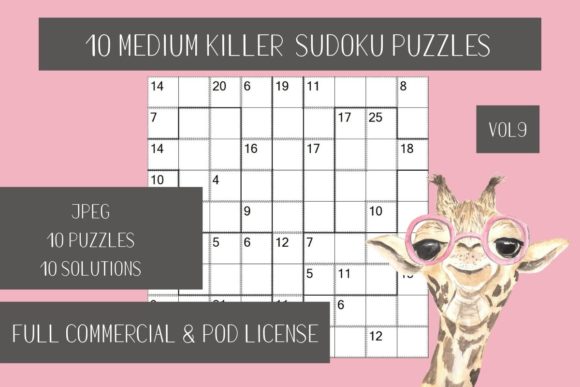
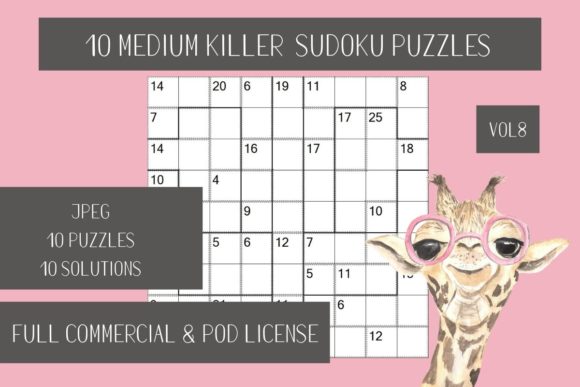
For content creators, self-publishers, and educators seeking reliable logic puzzle assets, sourcing high-quality material that balances difficulty with accessibility is a persistent challenge. 10 Medium Killer Sudoku Vol.10 addresses this specific niche by providing a curated set of medium-difficulty puzzles designed for both personal cognitive training and commercial integration into activity books. Unlike standard Sudoku, which relies solely on number placement, Killer Sudoku introduces arithmetic constraints through "cages," requiring solvers to utilize both logical deduction and mental math. This specific volume offers a practical solution for professionals who need consistent, watermark-free assets without the overhead of generating or verifying puzzles individually.
Asset Specifications and Technical Quality
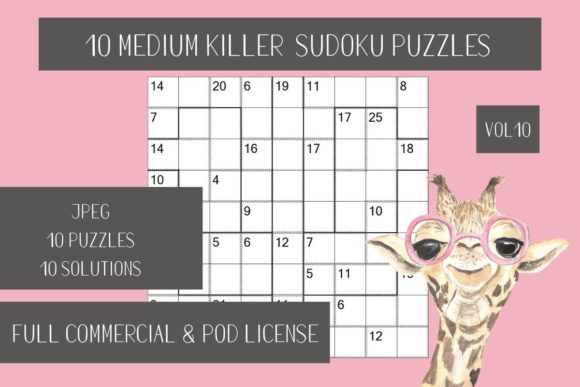
The primary value proposition for publishers and designers lies in the technical specifications of the deliverables. This package includes 10 distinct puzzle files and 10 corresponding solution files, totaling 20 JPEG images. Each file is rendered at 892×892 pixels with a resolution of 96 dpi. From a production standpoint, these dimensions are optimized for digital distribution and standard print formats up to approximately 9 inches square. The square aspect ratio ensures that the grid maintains perfect geometric integrity when placed into layout software like Adobe InDesign, Canva, or Affinity Publisher.
The absence of watermarks is a critical feature for commercial users. Many stock puzzle sites overlay intrusive branding that renders the asset unusable for paid products without expensive licensing upgrades. With 10 Medium Killer Sudoku Vol.10, the clean aesthetic allows for immediate integration into manuscripts, worksheets, or digital downloads. The 96 dpi resolution is particularly noteworthy; while 300 dpi is the industry standard for high-gloss print, 96 dpi is often sufficient for newsprint activity books, digital tablets, and web-based viewing where file size impacts load times and user experience. However, professionals planning large-format hardcover releases should verify that this resolution meets their specific printer’s minimum requirements before finalizing layouts.
Understanding the Medium Difficulty Curve
Defining "medium" in the context of Killer Sudoku is subjective, yet essential for audience retention. In this volume, the medium classification indicates a balanced intersection between cage complexity and grid logic. Solvers will encounter cages that require multi-step arithmetic combinations rather than single-cell giveaways, but the puzzles avoid the exhaustive trial-and-error often associated with expert-level grids. This makes the content appropriate for adults aged 20–50 who possess basic Sudoku proficiency but may not be competitive speed-solvers.
For entrepreneurs creating subscription boxes or educational supplements, this difficulty tier serves as a retention tool. Puzzles that are too easy lead to boredom, while those that are excessively difficult cause frustration and abandonment. The medium level found in 10 Medium Killer Sudoku Vol.10 targets the "flow state," where the challenge matches the solver's skill level. This is particularly valuable for marketers and bloggers using puzzles as lead magnets; the goal is to provide enough engagement to demonstrate value without alienating potential subscribers who are new to the variant.
Practical Applications for Publishers and Educators
The versatility of these assets extends beyond simple entertainment. For small business owners and freelancers in the education sector, Killer Sudoku serves as an effective tool for developing numerical fluency and logical reasoning. Unlike rote memorization exercises, these puzzles require active working memory and pattern recognition. Teachers and tutors can utilize these printable files as supplementary material for math enrichment programs, adult education centers, or cognitive rehabilitation therapy.
- Activity Book Compilation: Self-publishers can use this volume as a standalone chapter or mix it with other logic puzzles to create varied content. The consistent visual style ensures a professional look across pages.
- Digital Products: Freelancers selling printable bundles on platforms like Etsy or Gumroad can include these files as part of a larger "Brain Training" package. The separate solution files allow customers to verify their work independently.
- Corporate Wellness: HR professionals and corporate trainers looking for non-digital team-building or stress-relief activities can print these puzzles for workshops. The medium difficulty is inclusive enough for diverse teams without being intimidating.
- Content Marketing: Bloggers in the productivity or lifestyle niche can embed these images directly into posts discussing focus, mindfulness, or brain health, providing tangible value to readers beyond text.
Workflow Integration and Usability Assessment
In real-world application, the usability of 10 Medium Killer Sudoku Vol.10 depends heavily on the user's existing workflow. Because the files are delivered as rasterized JPEGs rather than vector graphics, they cannot be edited to change numbers or adjust line weights. This limitation is actually a strength for users who want guaranteed accuracy and do not wish to spend time proofreading generated puzzles. What you see is what you get: a tested, verified puzzle ready for placement.
However, this format requires careful handling during the design phase. When resizing, users must maintain the aspect ratio to prevent distortion of the grid lines and numbers. Since the background is likely white, placing these puzzles on colored backgrounds in a layout program may require masking or blending adjustments. For digital-only products, the 892px width provides ample clarity on retina displays while keeping file sizes manageable for email attachments or instant downloads. Professionals should organize the puzzle and solution files systematically upon download, perhaps renaming them to match their project’s internal naming convention, to streamline the assembly process.
Evaluating Long-Term Value and Limitations
When assessing the return on investment for 10 Medium Killer Sudoku Vol.10, consider the cost of alternative methods. Generating unique, error-free Killer Sudoku puzzles programmatically requires specialized software and significant validation time. Commissioning custom puzzles from artists or puzzle constructors can cost significantly more per unit. This pre-made set offers a cost-effective middle ground for projects requiring moderate volumes of content.
It is important to recognize realistic limitations. As a static set of 10 puzzles, this volume is insufficient as the sole content source for a full-length book. It functions best as a modular component or a sampler. Additionally, because the puzzles are medium difficulty, they may not satisfy niche audiences specifically seeking extreme challenges or beginner tutorials. Users targeting those demographics would need to supplement this pack with other resources. Furthermore, while the lack of watermarks permits commercial use, buyers should always review the specific license terms regarding redistribution to ensure compliance with platform policies.
Strategic Recommendations for Implementation
To maximize the effectiveness of these assets, consider the presentation context. Killer Sudoku relies heavily on clear delineation between cages and grid lines. When printing, ensure your printer settings are configured for "Actual Size" rather than "Fit to Page" to preserve the intended stroke weight and readability. For digital distribution, test the files on multiple devices to confirm that the cage totals remain legible at various zoom levels.
For creators building a brand around logic puzzles, consistency is key. If you plan to release multiple volumes or activity books, using assets from the same series or creator helps establish a recognizable visual identity. 10 Medium Killer Sudoku Vol.10 can serve as a benchmark for quality; if this set meets your standards, exploring additional volumes in the series could streamline future production cycles. Conversely, if you find the style incompatible with your brand, identifying this mismatch early saves time and resources.
Ultimately, this resource is best suited for pragmatic users who prioritize utility over novelty. It removes the friction of puzzle creation and verification, allowing professionals to focus on packaging, marketing, and distribution. Whether you are an educator enhancing a curriculum, a publisher filling a gap in an activity book, or a freelancer diversifying your digital product catalog, this set provides a reliable foundation. By understanding its technical parameters and appropriate use cases, you can integrate these puzzles effectively into your broader creative or educational strategy, delivering genuine value to your end users while maintaining efficient production workflows.