Evaluating the Daily Planner Interior for Custom Publishing
Selecting the right foundational template is a critical step for self-publishers, stationery designers, and productivity enthusiasts creating physical planning tools. The Daily Planner Interior serves as a pre-formatted digital asset designed to streamline the production of 8.5 x 11-inch planners. Rather than designing a layout from scratch, users acquire a structured framework that balances functional utility with technical print specifications. This evaluation explores the practical applications, technical considerations, and decision-making factors associated with this specific interior package to determine its alignment with various publishing goals.
Defining the Product Scope and Specifications
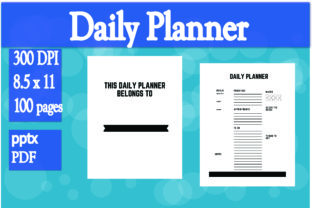
The Daily Planner Interior is fundamentally a hybrid digital product intended for print-on-demand (POD) or professional offset printing. It distinguishes itself through format flexibility, providing both a static PDF file and an editable PPTX file. This dual-format approach addresses two distinct user needs: immediate deployment and iterative customization. The standard dimensions are set at 8.5 x 11 inches, which corresponds to the US Letter size, a common standard for academic, professional, and home organization markets.
Technical fidelity is a primary consideration for any printable interior. This product specifies a resolution of 300 DPI (dots per inch), which is the industry benchmark for crisp text and line art in physical books. Lower resolutions often result in pixelation or blurriness when printed, particularly on uncoated paper stocks commonly used for planners. Additionally, the package includes 100 pages of content, providing sufficient volume for a quarterly planner or a condensed annual overview without exceeding typical spine width limitations for softcover binding. A notable feature for commercial creators is the absence of watermarks, ensuring the final product appears professionally authored rather than derivative.
Functional Utility and Customization Potential
The inclusion of a "This Daily Planner belongs to" page with illustration serves as more than mere decoration; it establishes ownership and adds perceived value to the end-user experience. For sellers, this front matter reduces the need for separate design work on introductory pages. However, the core value proposition lies in the PPTX file. While many interiors are sold exclusively as locked PDFs, the PowerPoint source file allows users to modify fonts, adjust margin widths, add branding elements, or restructure daily fields.
This editability transforms the product from a static template into a base layer for unique intellectual property. Users can adapt the generic daily structure to niche audiences, such as teachers, nurses, or project managers, by simply altering headers or adding specialized tracking sections. For those lacking advanced graphic design skills in software like Adobe InDesign or Affinity Publisher, PowerPoint offers a familiar interface for making these necessary adjustments. This lowers the barrier to entry for creating customized stationery while maintaining consistent page alignment and margins.
Benefits for Publishers and Creators
- Time Efficiency: Designing a 100-page interior with consistent gutters, bleed areas, and safe zones requires significant technical knowledge and time. This pre-validated layout eliminates hours of formatting work.
- Commercial Readiness: The lack of watermarks and high-resolution output means the file is ready for direct upload to platforms like Amazon KDP, Lulu, or IngramSpark without requiring post-processing cleanup.
- Risk Mitigation: Using a tested template reduces the likelihood of printing errors related to margin violations or low-resolution assets, which are common causes of rejection in POD ecosystems.
- Scalability: The editable nature allows for the creation of multiple SKU variations (e.g., dated vs. undated, different cover themes) from a single master file.
Tradeoffs and Technical Considerations
Despite its utility, the Daily Planner Interior presents specific tradeoffs that must be weighed against project requirements. The reliance on PowerPoint for editing, while accessible, has limitations compared to professional typesetting software. Text flow between linked boxes may not be automatic, and complex typographic controls are limited. Users accustomed to vector-based design tools may find the workflow restrictive or less precise.
Furthermore, the 8.5 x 11 dimension, while standard, is not universal. Markets preferring A4, A5, or B6 sizes will require resizing, which can disrupt layout proportions and necessitate a complete redesign of margins and safe zones. The 100-page count is also a fixed constraint; users requiring 120+ pages for a full-year undated planner will need to duplicate and merge files manually, potentially introducing pagination inconsistencies if not managed carefully. Finally, because this is a pre-made template, there is an inherent risk of market saturation. If multiple sellers use the unmodified version, products may appear identical in search results, necessitating customization to maintain competitive differentiation.
Situational Fit Analysis
Determining whether this Daily Planner Interior is appropriate depends heavily on the user’s current resources and objectives. The product represents a strong fit for entrepreneurs testing new niches in the low-content book space. The low time investment allows for rapid prototyping of concepts without committing to expensive custom design services. It is equally suitable for corporate trainers, coaches, or educators who require branded handouts or organizational tools for workshops but do not possess in-house design teams. The ability to quickly insert logos and modify terminology makes it a practical operational tool rather than just a retail product.
Conversely, alternatives may be worth considering for established stationery brands where unique visual identity is the primary selling point. If a brand’s value proposition relies on proprietary layouts or distinctive artistic styles, a generic template—even an editable one—may dilute brand equity. Similarly, users targeting international markets should verify if US Letter sizing aligns with local expectations before acquisition. For those requiring complex integrated systems (e.g., monthly calendars linked to weekly spreads with automated date population), dedicated planner design software or hiring a professional typesetter may yield superior functional results despite higher upfront costs.
Practical Decision-Making Insights
When evaluating this Daily Planner Interior against other options, prospective users should conduct a gap analysis between the provided template and their desired end state. Review the PPTX file structure before purchase if possible, or immediately upon acquisition, to assess layer organization and ease of editing. Verify that the font licensing included permits commercial use for the intended distribution channel, as some templates include personal-use-only typefaces that require replacement for retail products.
Consider the long-term workflow implications. If you plan to produce a series of planners, ensure the template’s style is versatile enough to serve as a cohesive series foundation. Evaluate whether the 300 DPI specification meets the requirements of your chosen printer; while standard for most, some premium art printers may prefer vector PDFs over rasterized content for absolute sharpness. Ultimately, this product functions best as a strategic accelerator rather than a complete solution. Its value is realized not merely in owning the file, but in leveraging the time saved to focus on marketing, audience research, and value-added customization that distinguishes the final planner in a crowded marketplace. By objectively assessing these technical and strategic factors, creators can determine if this interior aligns with their production capabilities and business objectives.