Evaluating the 5 Years Planner Interior for Self-Publishing
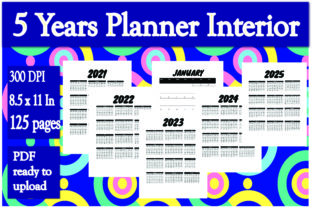
Selecting the right interior template is a foundational step in creating a successful low-content or medium-content book on self-publishing platforms. The 5 Years Planner Interior is a specific digital asset designed to streamline this process for publishers targeting the long-term organization niche. This product provides a pre-formatted PDF file containing monthly calendars spanning from 2021 through 2025, alongside lined notes pages. With dimensions set at 8.5 x 11 inches and a resolution of 300 DPI, it meets standard print quality requirements. However, determining whether this specific 125-page layout aligns with your publishing strategy requires an objective assessment of its features, limitations, and market fit.
Understanding the Product Specifications
The 5 Years Planner Interior is structured as a comprehensive organizational tool covering a half-decade span. Unlike annual planners that require yearly repurchasing, this format offers longevity. The interior includes every day from January 1st to December 31st for the years 2021, 2022, 2023, 2024, and 2025. The total page count is 125 pages, which creates a relatively slim volume compared to daily planners that often exceed 300 pages.
Technical specifications are critical for print-on-demand success. This file is delivered at 300 DPI, ensuring crisp text and grid lines without pixelation. The 8.5 x 11 inch trim size is the industry standard for functional planners, offering ample writing space while remaining compatible with standard KDP and IngramSpark printing options. The inclusion of lined notes pages adds utility beyond simple date tracking, allowing users to combine scheduling with journaling or project planning within a single volume.
Strategic Advantages for Publishers
For self-publishers, time-to-market is often a significant metric. Creating a five-year calendar layout manually involves complex formatting to ensure dates align correctly across leap years and varying month lengths. Utilizing a pre-made 5 Years Planner Interior eliminates the risk of calendrical errors, which are among the most common causes of negative reviews in the planner category. The ready-to-upload PDF format allows publishers to focus resources on cover design, keyword research, and marketing rather than interior typesetting.
Furthermore, the multi-year aspect addresses a specific consumer pain point: continuity. Users who prefer to track long-term goals, business milestones, or family events often find annual planners insufficient. By offering a five-year horizon, this interior targets a demographic seeking stability and long-range visibility. The addition of lined notes pages also increases the perceived value of the book, transforming it from a simple calendar into a hybrid productivity tool.
Assessing Content Relevance and Date Ranges
A primary consideration when evaluating this interior is the specific year range included. Because the planner covers 2021 through 2025, its commercial viability is time-sensitive. For current publishing projects, the past years (2021-2023) may be viewed as obsolete by some buyers, while others may appreciate them for retrospective journaling or backlog tracking. Publishers must carefully consider how to position a planner that includes past dates. Marketing copy should clarify whether these sections are intended for historical record-keeping or if the primary value lies in the remaining current and future years.
If your target audience strictly requires forward-looking planning, the inclusion of past years could be a friction point. Conversely, for niches like "five-year memory keeping" or "business anniversary tracking," the full date range is a feature rather than a flaw. Evaluating your specific niche's relationship with time is essential before adopting this template.
Tradeoffs and Practical Considerations
While the 5 Years Planner Interior offers convenience, it presents distinct tradeoffs compared to custom-designed interiors. The fixed 125-page count results in a concise book, which keeps printing costs low and royalties potentially higher. However, this brevity means there is limited space per month. Users accustomed to expansive weekly spreads or dedicated goal-setting sections may find this monthly-only format too minimal.
Additionally, using a commercially available template means other publishers may have access to the identical interior. In a saturated marketplace, differentiation becomes challenging. If multiple books share the same internal structure, competition shifts entirely to cover design, pricing, and advertising efficiency. Publishers relying on this interior must invest significantly in unique branding to avoid their listing appearing generic. Customization options are also limited; since the file is a ready-to-upload PDF, adding proprietary content such as habit trackers, holiday lists, or specialized prompts would require advanced editing skills or purchasing additional assets to merge.
Print Quality and User Experience Expectations
The 300 DPI resolution ensures professional print quality, but publishers should always order a proof copy before launching. Paper thickness in print-on-demand services can vary, and high-contrast black ink on white paper is generally safe. However, if you plan to modify the interior by adding gray shading or colored elements, verify that the contrast remains sufficient for readability on standard cream or white book paper. The 8.5 x 11 size is versatile, but it is larger than some portable personal planners. Understanding that this product serves a desk-based or home-office function rather than a pocket-carry function helps in setting accurate customer expectations.
Determining Fit for Your Publishing Goals
The 5 Years Planner Interior is best suited for publishers who prioritize speed and cost-efficiency over bespoke interior design. It is a strong fit for those entering the long-term planner niche who lack the technical skills to format multi-year calendars accurately. It also serves well as a supplementary product in a broader catalog, providing a low-risk entry point to test market demand for five-year formats.
Alternatively, this template may not be appropriate for publishers aiming to build a premium brand centered on unique user experiences. If your business model relies on high price points justified by exclusive content, a stock interior may undermine your value proposition. Similarly, if your niche requires specific non-standard layouts—such as academic years, fiscal quarters, or lunar cycles—this standard Gregorian monthly format will not meet user needs. In such cases, investing in custom design or seeking specialized templates is a more viable path.
Making an Informed Decision
Ultimately, the decision to use the 5 Years Planner Interior should be based on a clear alignment between the product’s attributes and your target audience’s requirements. Evaluate the date range against current market needs and determine if the inclusion of past years supports or hinders your positioning. Assess whether the 125-page monthly format provides sufficient utility for your specific niche or if it lacks necessary depth.
By treating this interior as a strategic component rather than a standalone solution, publishers can effectively leverage its technical readiness while mitigating the risks associated with commoditized content. Success in self-publishing depends not just on having a functional file, but on understanding how that file serves the end-user within a competitive ecosystem. Careful evaluation of these factors ensures that the 5 Years Planner Interior contributes positively to a sustainable publishing portfolio.