One Line a Day 5 Years Challenge: A Practical Approach to Lasting Memory Keeping
The One Line a Day 5 Years Challenge is less about perfect penmanship or profound prose and more about capturing the texture of daily life in manageable increments. At its core, this practice involves recording a single sentence, thought, or observation every day for five consecutive years. The unique structure allows you to see entries from previous years on the same page, creating an instant time capsule that reveals patterns, growth, and forgotten moments. Unlike traditional journaling, which can feel like a chore when life gets busy, this method respects your time while preserving your history. It transforms the overwhelming task of documentation into a two-minute ritual that compounds into a rich personal archive.
Why Brevity Works for Busy Adults
For adults navigating careers, parenting, or higher education, the barrier to entry for journaling is often the perceived time commitment. Writing three pages of stream-of-consciousness thoughts at 10 PM is simply not sustainable for everyone. The One Line a Day 5 Years Challenge solves this friction point by lowering the stakes. You are not writing a memoir; you are leaving breadcrumbs for your future self.
This brevity forces a specific type of mindfulness. When you only have one line, you must distill the day’s essence. Did you get the promotion? Did your toddler say something hilarious? Was the sunset particularly striking? Or was it just a hard, exhausting Tuesday? All of these are valid. Over time, this constraint trains your brain to identify what actually matters amidst the noise of modern living. It captures the emotional weather of your life without requiring hours of introspection.
Real-World Scenarios and Use Cases
The versatility of this format makes it applicable across vastly different lifestyles and professional fields. It is not merely a sentimental exercise but a functional tool for various demographics.
New Parents and Caregivers
The early years of childhood pass with disorienting speed. Parents often find themselves unable to recall specific milestones because they were too exhausted to document them in detail. A 6”x9” journal fits easily on a nightstand or in a diaper bag. Recording "First solid food today, hated the peas" takes seconds during a nap break. Five years later, that same page might hold "Started kindergarten, cried at drop-off," providing a tangible timeline of development that photos alone cannot convey.
Entrepreneurs and Creatives
For those building businesses or creative portfolios, memory is a professional asset. Ideas often strike in fleeting moments between meetings or during commutes. Using this challenge as an idea incubator allows you to track the evolution of projects. You might note "Brainstormed rebrand concept on train" in year one, and "Launched new brand identity" in year three. This creates a searchable index of your creative process and helps identify seasonal trends in your productivity or inspiration.
Mental Health and Personal Growth
Therapists often recommend journaling to track triggers and progress, but blank pages can be intimidating during depressive episodes. The structured nature of pre-dated or lined sections removes the pressure of formatting. For someone managing anxiety or recovery, seeing "Felt overwhelmed by noise" on the same date three years ago, followed by "Enjoyed a quiet concert tonight" this year, provides objective evidence of resilience. It serves as a grounding anchor, proving that current struggles are temporary and that growth is non-linear but real.
Students and Lifelong Learners
University students or professionals pursuing certifications can use this format to track academic journeys. Instead of dense study notes, capture the meta-experience of learning: "Finally understood organic chemistry mechanisms" or "All-nighter before finals, need better schedule." Years later, this becomes a record of intellectual perseverance and personal development alongside academic achievement.
Design Features That Support Consistency
Success in any long-term habit relies heavily on the tools used. A poorly designed journal will be abandoned; a well-designed one invites interaction. When selecting a resource for the One Line a Day 5 Years Challenge, specific physical attributes directly impact usability.
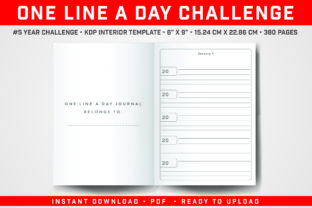
- Optimal Dimensions: The 6”x9” (15.24cm x 22.86cm) size is the sweet spot for portability and writability. It is large enough to accommodate ten separate lined areas per spread without feeling cramped, yet compact enough to travel with. This dimension fits standard bookshelves and bags, ensuring the journal remains accessible rather than stored away.
- Structured Layout: Having two pages with ten separate lined areas prevents bleed-through confusion and keeps entries distinct. This visual separation is crucial when comparing years. If lines run together, the comparative aspect of the challenge is lost. Clear demarcation helps the eye scan vertically through time.
- Monthly Reflection Space: Life does not always fit neatly into daily lines. Dedicated NOTES pages at the end of every month provide necessary overflow space. This is where you can expand on a significant event, paste a ticket stub, or write a longer reflection that the daily line could not contain. This hybrid approach prevents frustration when one line feels insufficient.
- No Bleed Printing: For those who prefer gel pens, markers, or fountain pens, no-bleed paper is non-negotiable. Ink ghosting ruins the readability of previous years' entries. Ensuring the PDF or print file is formatted with no bleed guarantees that the archival quality remains intact regardless of writing instrument choice.
Practical Considerations Before Starting
While the concept is simple, execution requires realistic expectations. Understanding potential pitfalls helps in choosing the right format and maintaining the habit.
Digital vs. Physical Formats
A ready-to-upload PDF format offers distinct advantages over pre-bound books. It allows for customization and reprinting. If you ruin a page or want to restart, you can simply print a fresh copy. Digital files also enable users to bind the journal locally or use print-on-demand services to create multiple copies for different family members. However, some users find the tactile experience of a permanent, pre-bound book more motivating. Consider whether you value flexibility and cost-effectiveness (PDF) or the ceremonial weight of a finished artifact.
Handling Missed Days
Perfectionism is the enemy of completion. You will miss days. You might miss weeks. The design of having ten separate lined areas rather than strict calendar dates offers forgiveness. If you skip March 12th, the line remains available for a late entry or can simply stay blank. The goal is accumulation, not perfection. Choosing a format that doesn't shame empty spaces is vital for long-term adherence.
Privacy and Security
Because this journal spans five years and contains intimate reflections, security matters. A physical journal needs a safe storage location, especially in shared households. Digital PDFs printed at home offer more control over who sees the content. Conversely, cloud-stored digital journals carry data breach risks. Weigh your privacy needs against convenience when deciding how to maintain your record.
Maximizing the Value of Your Entries
To get the most out of this challenge, vary the content of your lines. If every entry is "Went to work, tired," the archive will lack richness. Mix factual events with sensory details and emotional states. Note the song stuck in your head, the price of coffee, the headline that made you angry, or the compliment that made your day. These seemingly trivial details become the most evocative triggers for memory retrieval years later.
Consider using the opening page intentionally. Labeling it clearly with "One Line A Day Journal" and a "Belongs To" section establishes ownership and intention. It signals that this object has purpose. Some users add a photo or a statement of intent on this page to reconnect with their motivation whenever they open the book after a hiatus.
Ultimately, the One Line a Day 5 Years Challenge is an investment in your future perspective. Whether you are tracking business metrics, child development, mental health recovery, or simply the passage of time, the cumulative effect of 380 pages of distilled experience is profound. It turns the ephemeral nature of daily existence into something tangible, reviewable, and deeply personal. By choosing a format that supports your specific lifestyle—whether through thoughtful sizing, monthly note sections, or flexible printing options—you transform a simple writing prompt into a lifelong companion.