Streamlining KDP Publishing: The Strategic Value of a No-Bleed Piano Sheet Music Template
The landscape of self-publishing has evolved significantly over the last decade, transitioning from a niche hobbyist pursuit to a sophisticated segment of the digital economy. Within this ecosystem, Amazon’s Kindle Direct Publishing (KDP) platform has become a cornerstone for entrepreneurs, musicians, and educators seeking to monetize their expertise or create passive income streams. Among the various low-content and medium-content book categories, music manuscripts remain a perennial bestseller. However, success in this saturated market no longer comes from simply uploading generic lines on a page; it requires precision, professional formatting, and an understanding of current consumer preferences. This is where a specialized Piano Blank Sheet Music KDP Interior becomes an essential asset for serious creators.
For professionals and freelancers navigating the print-on-demand space, time is the most valuable currency. Creating a manuscript from scratch involves complex margin calculations, staff line spacing adjustments, and repetitive formatting tasks that can consume dozens of hours. A pre-formatted template eliminates this friction, allowing publishers to focus on marketing, niche research, and brand building rather than graphic design troubleshooting. Specifically, a template designed with a no-bleed 8.5 x 11 specification addresses the most common technical hurdles in KDP publishing while meeting the exacting standards of modern musicians and students.
The Technical Advantage of No-Bleed Design in Music Publishing
One of the most critical decisions in creating a piano sheet music book is choosing between bleed and no-bleed formats. While bleed designs allow images to extend to the edge of the paper, they introduce significant complexity regarding safe zones and trim margins. For functional books like sheet music journals or composition notebooks, a no-blank sheet music book template with standard margins is often superior for both the creator and the end-user.
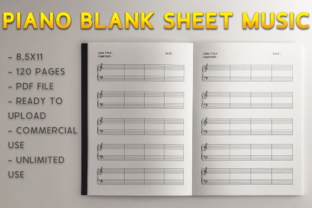
The 8.5 x 11 inch dimension is the industry standard for piano literature in North America. It provides ample vertical space for grand staff notation without requiring excessive page turns during performance. When utilizing a no-bleed design, the content is contained within a defined safe area, ensuring that no musical staves are accidentally cropped during the printing process. This reliability is paramount for customer satisfaction. Musicians are notoriously particular about layout; if a measure is cut off or the binding eats into the playable area, the book receives negative reviews regardless of the cover quality. By using a verified PDF template with 120 pages of pre-set interior layouts, publishers mitigate the risk of formatting errors that frequently plague amateur submissions.
Aligning with Educational and Creative Trends
The demand for high-quality blank sheet music books is not merely a function of vanity publishing; it is deeply connected to broader shifts in music education and creative expression. We are currently witnessing a resurgence in analog creativity as a counterbalance to digital fatigue. While notation software like Sibelius or Dorico dominates professional engraving, there is a growing preference among composers, songwriters, and students for tactile, paper-based ideation. The physical act of writing music engages different cognitive processes than clicking notes into a MIDI interface, fostering deeper learning and retention.
Furthermore, the rise of independent music pedagogy has created a micro-economy for specialized teaching resources. Private tutors and homeschooling parents often seek customizable or standardized workbooks that fit specific curricula. A well-structured KDP template allows these educators to publish branded materials quickly. Instead of relying on mass-market options that may include unnecessary clutter or incorrect spacing, they can utilize clean, professional interiors tailored to their students' needs. This trend toward personalized educational tools makes the availability of reliable templates more relevant than ever before.
Economic Efficiency for Low-Content Publishers
From a business perspective, the viability of low-content publishing relies heavily on volume and speed to market. The barrier to entry on KDP is low, but the barrier to profitability is rising. Consumers have become adept at identifying low-effort products. Therefore, the value proposition of a premium template lies in its ability to elevate the perceived quality of the final product without increasing production costs.
Consider the workflow of a freelance publisher managing multiple niches. Developing a unique interior for every new title is economically unfeasible. By integrating a standardized Piano Blank Sheet Music KDP Interior into their asset library, they achieve economies of scale. The instant download nature of these PDF files means there is zero latency between purchase and production. This agility allows marketers to test multiple cover designs against the same proven interior, isolating variables to determine what drives sales. In an environment where algorithm visibility changes weekly, the ability to iterate rapidly is a competitive advantage.
User Experience and Functional Design
Beyond the economics of publishing, we must consider the user experience (UX) of the physical book. A template is not just a collection of lines; it is a designed interface for musical thought. High-quality templates account for optical spacing, ensuring that the distance between treble and bass clefs is visually balanced. They also consider binding margins, leaving sufficient white space near the gutter so that the book can lie flat or be easily read when open. These subtle design choices distinguish a professional publication from a homemade document.
When a customer purchases a blank sheet music book, they are purchasing potential. They expect the paper to accept pencil marks without smudging, the lines to be crisp but not overpowering, and the layout to facilitate rather than hinder their workflow. A 120-page count strikes an optimal balance between substantial value and manageable spine width for softcover printing. This page count is thick enough to feel like a legitimate resource but thin enough to keep printing costs low, maximizing royalty margins for the publisher while maintaining an attractive price point for the consumer.
Navigating the KDP Upload Process with Precision
Even the best template can fail if implemented incorrectly. Understanding the technical integration of the file into the KDP ecosystem is part of the professional workflow. When utilizing a no-bleed 8.5 x 11 PDF template, the upload process requires specific attention to detail to ensure the previewer approves the file without flagging margin warnings.
- File Verification: Before uploading, always open the downloaded PDF to verify that all 120 pages are present and that the dimensions read exactly 8.5 x 11 inches in your PDF viewer properties. Corrupted downloads or resized files are common sources of error.
- KDP Settings Selection: During the book setup phase, select "Black & White Interior with White Paper." Crucially, you must select No Bleed when prompted for bleed settings. Selecting "Bleed" for a no-bleed template will alter the required trim size and cause immediate rejection.
- Cover Alignment: Because the interior is no-bleed, your cover file must still account for bleed, but the interior content will remain safely centered. Use the KDP cover calculator to generate a template that matches your exact page count (120 pages) and paper type to ensure the spine aligns perfectly with the interior block.
- Preview Review: Never skip the online previewer. Zoom in to check the inner margins on both left and right-hand pages. Ensure that the header and footer areas (if included) do not encroach upon the safe zone. The automated checker is helpful, but visual confirmation is mandatory for quality assurance.
The Future of Niche Publishing Assets
As artificial intelligence and automation continue to reshape content creation, the value of verified, human-centric design assets increases. AI can generate images and text, but it currently struggles with the precise typographic rigors required for functional music notation. A dedicated Piano Sheet Music Book Template represents a fusion of traditional craftsmanship and modern distribution efficiency. It acknowledges that while technology accelerates production, certain standards of utility and aesthetics remain constant.
For entrepreneurs and creators, investing in high-quality foundational assets is a strategic move toward sustainability. Rather than chasing fleeting trends with disposable content, building a catalog based on reliable, professionally formatted interiors creates long-term equity. The piano sheet music niche is enduring because the need to learn, compose, and teach music is fundamental to human culture. By leveraging optimized tools, publishers can serve this community more effectively, turning a simple PDF download into a vehicle for creative empowerment and business growth.
Ultimately, the relevance of this template extends beyond its immediate utility. It serves as a case study in how digital products can bridge the gap between abstract creativity and tangible commerce. Whether you are a seasoned KDP veteran looking to streamline operations or a musician seeking to self-publish your own curriculum, understanding the nuances of no-bleed formatting and standard sizing is the first step toward professional excellence. In a marketplace crowded with noise, precision is the signal that customers trust and reward.