Streamlining KDP Publishing: The Strategic Value of a Professional Lined Notebook Interior
The landscape of self-publishing has shifted dramatically over the last decade. What began as a niche avenue for authors to bypass traditional gatekeepers has evolved into a sophisticated ecosystem where entrepreneurs, marketers, and creatives build sustainable businesses around low-content and no-content books. Within this competitive marketplace, the quality of your product’s infrastructure is just as critical as the cover design that attracts the initial click. This is where a professionally engineered Lined Notebook Interior becomes a pivotal asset for any serious Amazon KDP publisher.
For professionals and enthusiasts entering the print-on-demand space, the distinction between a generic template and a purpose-built interior file can determine long-term profitability. A high-quality Lined Notebook Interior is not merely a collection of horizontal lines; it is a foundational product designed specifically for the technical and aesthetic demands of the KDP low-content business model. Whether utilized as a standard notebook, a structured journal, or an undated planner, this resource bridges the gap between rapid production and professional-grade publishing standards.
The Evolution of Low-Content Publishing Standards
In the early stages of the KDP gold rush, the barrier to entry was low, but so was the quality ceiling. Many publishers relied on free, low-resolution templates or hastily generated PDFs that resulted in poor printing outcomes and negative customer reviews. Today, consumer expectations have matured alongside the platform. Buyers are no longer satisfied with pixelated lines or improper margins. They demand crisp typography, correct bleed settings, and paper-friendly contrast levels that prevent ink bleed-through during use.
This shift mirrors broader trends in digital commerce where user experience (UX) dictates success. Just as a website must be optimized for navigation and speed, a physical notebook must be optimized for usability. A premium Lined Notebook Interior addresses these evolving needs by providing files that adhere strictly to current printing specifications. This attention to detail signals to both the algorithm and the consumer that the product is legitimate, thereby reducing return rates and improving organic ranking through better engagement metrics.
Versatility Across Sizes and Use Cases
One of the most significant challenges for KDP entrepreneurs is managing inventory across multiple niches without spending hundreds of hours formatting individual books. The modern publishing workflow requires scalability. A comprehensive Lined Notebook Interior package solves this bottleneck by offering pre-formatted sizes that cover the vast majority of market demand. Specifically, having access to precise dimensions ensures that you can pivot quickly between trending categories.
The inclusion of specific trim sizes allows publishers to target distinct demographics effectively:
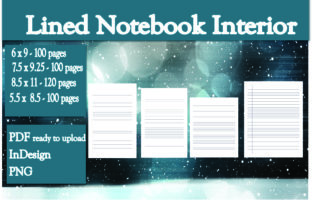
- 5.5 x 8.5 inches (100 pages): This compact size is ideal for travel journals, pocket notebooks, and gratitude diaries. It appeals to consumers looking for portability and intimacy in their writing experience.
- 6 x 9 inches (100 pages): Often considered the industry standard for trade paperbacks, this size strikes a perfect balance between portability and writing space. It is the go-to format for general-purpose notebooks and composition books.
- 7.5 x 9.25 inches (100 pages): A slightly larger format that offers a premium feel without being cumbersome. This size is increasingly popular for executive journals and specialized planners where a bit more width enhances readability.
- 8.5 x 11 inches (120 pages): The classic letter size remains essential for academic notebooks, work logs, and detailed project planning. The increased page count in this format maximizes value perception for utility-focused buyers.
By utilizing a pre-sized Lined Notebook Interior, creators eliminate the risk of formatting errors that frequently lead to rejected uploads or misprinted interiors. This reliability is crucial when scaling a catalog to hundreds of SKUs.
Customization and Creative Control with InDesign
While ready-to-upload PDFs offer speed, true brand building requires differentiation. The market is saturated with identical interiors, making it difficult for new entrants to stand out. This is why access to source files is a non-negotiable requirement for professional publishers. The inclusion of an InDesign file transforms a static template into a dynamic design canvas.
Adobe InDesign remains the industry standard for layout design because it offers precision that word processors cannot match. With the editable INDD file, you can modify line spacing to suit specific handwriting styles, adjust margins to accommodate binding shifts, or integrate proprietary branding elements such as logos, headers, footers, and motivational quotes. This level of customization allows you to create a unique selling proposition (USP) within a commoditized category.
Furthermore, the ability to edit the Lined Notebook Interior directly supports niche marketing strategies. For example, a publisher targeting nurses might add medical reference charts to the front matter, while one targeting real estate agents could include property inspection checklists. These micro-adjustments, made possible through the source file, turn a generic notebook into a specialized tool, significantly increasing its perceived value and conversion rate.
Technical Integrity and File Formats
Success in print-on-demand relies heavily on technical accuracy. A single millimeter of error in margin settings can result in text being cut off or lines drifting into the gutter. Professional-grade assets mitigate this risk through rigorous quality control. When acquiring a Lined Notebook Interior, the presence of multiple file formats serves different stages of the production pipeline.
The PDF file is the final deliverable, optimized for direct upload to KDP. It should be flattened and export-ready, ensuring that what you see on screen is exactly what prints on paper. Simultaneously, the inclusion of PNG files provides flexibility for creating mockups, social media marketing assets, or digital previews without needing to open heavy layout software. This multi-format approach streamlines the workflow from creation to marketing.
Crucially, professional assets must be free of restrictive watermarks. There will be no watermarks of any kind on your product, ensuring that the final printed book looks pristine and commercial. Watermarks not only degrade the user experience but also violate platform terms of service if left in published works. Clean, unencumbered files are a hallmark of legitimate business tools designed for resale and distribution.
Aligning with Modern Creator Workflows
The relevance of a dedicated Lined Notebook Interior extends beyond simple convenience; it aligns with the changing nature of creative and entrepreneurial work. We are currently witnessing a "hybrid productivity" trend where digital natives are returning to analog tools to reduce screen fatigue and enhance cognitive retention. Notebooks are no longer just for students; they are integral components of adult workflows, used for bullet journaling, meeting notes, mental health tracking, and strategic planning.
As a publisher, you are essentially selling a productivity system wrapped in paper. Your customers are paying for the assurance that the tool will function correctly. By leveraging high-quality interiors, you respect the end-user's time and intent. This alignment with consumer lifestyle trends builds trust. When a customer receives a notebook with perfect margins, appropriate line weight, and ample page count, they associate that quality with your brand, leading to repeat purchases and positive word-of-mouth.
Future-Proofing Your Publishing Business
The low-content publishing industry is moving toward professionalism and sustainability. The era of uploading thousands of low-quality duplicates is ending, replaced by a focus on curated catalogs with genuine utility. Investing in superior assets like a versatile Lined Notebook Interior is a strategic move to future-proof your business against platform saturation and algorithm changes.
Moreover, owning editable source files protects you against obsolescence. If KDP updates its trim size tolerances or printing technology changes, having the InDesign file means you can update your master templates in minutes rather than recreating them from scratch. This agility is vital in a tech-driven publishing environment where adaptability equals survival.
Ultimately, the goal is to build an asset library that generates passive income through active quality management. Whether you are a freelancer testing the waters, a marketer expanding a brand, or a full-time publisher scaling operations, the right interior files provide the stability needed to grow. They allow you to focus less on technical troubleshooting and more on market research, cover design, and audience engagement—the activities that actually drive sales in today’s mature KDP ecosystem.
By integrating a professional Lined Notebook Interior into your production workflow, you are not just buying a template; you are investing in a standardized, scalable, and high-quality foundation for your publishing enterprise. In a market defined by visual appeal and functional reliability, this distinction is what separates fleeting experiments from enduring businesses.